

On Wednesday, December 9, 2026, the Latino Chamber of Commerce of Pueblo will host a ribbon cutting to celebrate a striking new addition to the Sangre de Cristo Arts and Conference Center: a prominently placed alebrije sculpture of a rabbit. We are proud to share that our team provided the geotechnical engineering for this installation. Public art brings color, culture, and conversation to downtown Pueblo, but it also has to stand up to wind, weather, and Southern Colorado soils for decades. In this post, we share the event details, explain why a sculpture needs geotechnical engineering in the first place, and walk through what goes into a stable foundation for outdoor art and other small structures in Pueblo, CO.
Join Us for the Alebrije Sculpture Ribbon Cutting in Pueblo, CO
Alebrijes are brightly painted, fantastical creatures rooted in Mexican folk art. The tradition is often traced to papier-mâché artist Pedro Linares in Mexico City, and it later grew to include the hand-carved wooden figures Oaxaca is known for today. Over time, alebrijes have become a beloved symbol of imagination and cultural pride, and larger outdoor versions now appear in public spaces across the Southwest. Seeing one take its place at an arts center that serves all of Southern Colorado is something worth celebrating.
Here is what you need to know if you would like to attend:
- When: Wednesday, December 9, 2026, from 3:00 PM to 4:00 PM MST
- Where: Sangre de Cristo Arts and Conference Center, 210 N Santa Fe Ave, Pueblo, CO 81003
- Hosted by: The Latino Chamber of Commerce of Pueblo
- What to see: The newly installed rabbit alebrije sculpture, positioned so visitors can enjoy it up close
This event is especially meaningful for us because the Arts Center has been a valued partner before. Our team previously worked with the Center on an interactive hyperloop display for its STEAM program, and we are glad to contribute to another piece that will welcome families, students, and visitors for years to come. As a Pueblo-based firm since 2005, we take real pride in helping projects that shape how our hometown looks and feels. You can explore more of the work we have supported in the region on our projects page.
Why Does a Sculpture Need Geotechnical Engineering?
When people walk up to a piece of public art, they look at the colors, the shape, and the craftsmanship. Very few people think about what is happening below the surface. Yet from an engineering standpoint, a large outdoor sculpture is a structure, and it deserves the same attention to ground conditions as a small building, a sign, or a light pole.
Sculptures create a few unique challenges. Their weight is often concentrated on a small footprint, which puts more pressure on the soil directly beneath the base. A tall, vertical figure also catches the wind, creating forces that try to tip it over. Because public art sits in spaces where people gather, including children who want to touch and climb, stability is a safety issue as much as an aesthetic one.
Settlement is another concern. If the soil under one side of a foundation compresses or moves more than the other, the piece can begin to lean. On a vertical sculpture, even a small tilt is easy to spot, and correcting it after installation is disruptive and costly. In some cases, it means lifting the artwork and rebuilding the base entirely.
Geotechnical engineering answers a simple but critical question: what is under the surface, and how will it behave over time? Our geotechnical and geological engineering work gives the structural engineer and installation team reliable data to design a base that keeps the artwork plumb, secure, and safe. We cover the bigger picture of this topic in our post on why geotechnical engineering matters for projects in Pueblo.
What Geotechnical Engineering for Outdoor Art and Monuments Involves
Every site is different, but geotechnical work for a sculpture, monument, or similar small structure generally follows a clear set of steps. The scope is usually smaller than it would be for a building, but the questions are the same, and skipping them can lead to the same kinds of problems.
Subsurface Investigation
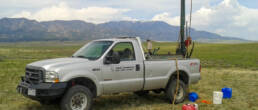
The process starts with understanding the ground. Depending on the site, this may include soil borings or test pits that reveal what lies beneath the surface layer. Our geotechnical field services team collects samples and records conditions at depth, such as soil type, moisture, and the presence of fill or bedrock.
Laboratory Testing of Soil Samples
Samples are tested to measure properties like moisture content, density, gradation, and how much the soil swells or compresses under load and changing moisture. With our AASHTO-accredited laboratory in-house, these results come back without waiting on an outside lab.
Bearing Capacity and Settlement Analysis
Using field and lab data, we evaluate how much load the soil can safely support and how much it may settle over time. This tells the design team how large and deep the foundation should be to carry the sculpture’s weight evenly. It also helps determine whether a shallow spread footing will work or whether a deeper option, such as a drilled pier, is the better fit for the site.
Overturning, Wind, and Frost Considerations
Tall pieces must resist tipping from wind and incidental contact. Foundations also need to extend below the local frost depth so freeze-thaw cycles do not heave the base. Our recommendations help the structural engineer account for all of these forces in one coordinated design, so the artwork, its mounting hardware, and its base all work together as a single system.
How Southern Colorado Soils Affect Foundations for Small Structures
Soil conditions across Pueblo and the surrounding region can vary a great deal, sometimes within a short distance. That variability is exactly why site-specific geotechnical engineering matters, even for a project that seems small.
One of the most common challenges in Southern Colorado is expansive clay. These soils swell when they absorb water and shrink as they dry out. For a foundation, that repeated movement can cause uneven lifting and settling. In some areas, shale bedrock sits relatively close to the surface and can also be sensitive to moisture changes, which affects how a foundation should be designed and how deep it should go.
Urban sites bring their own complications. Downtown properties often sit on decades of past development, which can mean old fill material, buried debris, abandoned foundations, or underground utilities near the planned location. Areas closer to the Arkansas River may have looser sands and gravels deposited over time. Each condition changes how the ground will respond to a new, concentrated load.
Climate plays a role as well. Our region sees dry periods, intense seasonal storms, and regular freeze-thaw cycles through the winter. Landscaping and irrigation around a new installation can also change soil moisture right where the foundation sits. A good geotechnical recommendation anticipates these shifts rather than reacting to them after problems appear.
If you want a deeper look at how early ground evaluations prevent problems, our post on geotechnical site investigations in Southern Colorado covers the topic in more detail. For a full overview of what we offer locally, visit our page on geotechnical and engineering services in Pueblo.
How Our Team Supports Community and Cultural Projects in Southern Colorado
Public art, museum installations, and community landmarks often come with tight timelines, limited budgets, and plenty of stakeholders. An arts organization may be coordinating with an artist, a fabricator, a structural engineer, a contractor, and the city all at once, often around a fixed unveiling date. In that setting, organizations need an engineering partner who can deliver dependable answers without unnecessary delays. Here is how we approach these projects:
- Local knowledge built over two decades. We have been based in Pueblo since 2005, so we understand the soil conditions, permitting expectations, and site challenges common to our region.
- In-house laboratory testing. Our AASHTO-accredited lab handles soil and materials testing under the same roof as our engineers, which keeps communication clear and turnaround efficient.
- Our own drill rigs. Because we operate our own drilling equipment, we can schedule field investigations around the project’s needs rather than a subcontractor’s availability.
- Support beyond the report. Through our construction quality control and assurance services, we can verify that foundation conditions and materials match the design once installation begins.
- Comfort with unconventional projects. Sculptures, displays, and one-of-a-kind installations rarely fit a standard template. Our work in engineering for innovative and emerging projects means we are ready to adapt.
Whether the project is a single sculpture or a larger civic improvement, our goal is the same: give the design team clear, practical recommendations so the finished work performs as intended. We also keep our reports readable for nonengineers, so board members, program directors, and donors can understand what the site requires and why it matters for the budget and schedule.
Planning Public Art or a Small Structure in Pueblo? A Quick Checklist
A successful installation starts long before the ribbon is cut, and a little planning at the start protects both the artwork and the investment behind it. If your organization is planning a sculpture, monument, sign, kiosk, or similar structure, keep these points in mind:
- Bring in a geotechnical engineer early, before the foundation design is finalized.
- Expect site-specific conditions, since soils can change significantly across short distances in Southern Colorado.
- Plan for expansive soils, frost depth, and wind loads, especially for tall or slender pieces.
- Account for past development, buried utilities, and old fill on downtown and urban sites.
- Consider how irrigation and drainage around the installation may affect soil moisture.
- Coordinate geotechnical recommendations with the structural engineer and installer.
- Build time for field work and lab testing into your schedule, especially if you are working toward a public unveiling date.
For homeowners, builders, and organizations who want to understand the testing side in plain terms, our guide to soil testing before you build in Colorado is a helpful next read.
Start Your Next Southern Colorado Project on Solid Ground
We are honored to have played a part in bringing the rabbit alebrije to the Sangre de Cristo Arts and Conference Center, and we hope you will join the community in celebrating it on December 9. Projects like this remind us that the ground beneath our work matters just as much as what rises above it. If your organization is planning public art, a community space, or any project that depends on a reliable foundation, our team is ready to help with geotechnical, civil, laboratory, and field services across Colorado, New Mexico, Arizona, and Mississippi. Request a consultation today, and let’s talk about what your site needs to succeed.
Need Engineering Support for Your Project?
Jesik Consulting & Engineering works with municipalities, utilities, and developers to deliver accurate data, efficient design, and dependable results. Connect with our team to discuss your project requirements.
Like this article? Spread the word!
Related Posts

September 1, 2026
Jesik Consulting & Engineering: Why Geotechnical Engineering Matters for Projects in Pueblo, CO
Discover why geotechnical engineering is essential for safe, cost-effective projects in…
November 2, 2026
Good Engineering Isn’t About Spending More Money
Good engineering balances safety and budget. See how cost-effective engineering protects…
November 1, 2026
Soil & Compaction Testing 101: What Contractors Need to Know Before Pouring
Learn how soil compaction testing works, from Proctor targets to field density tests, and…